
HEWELIUSZ
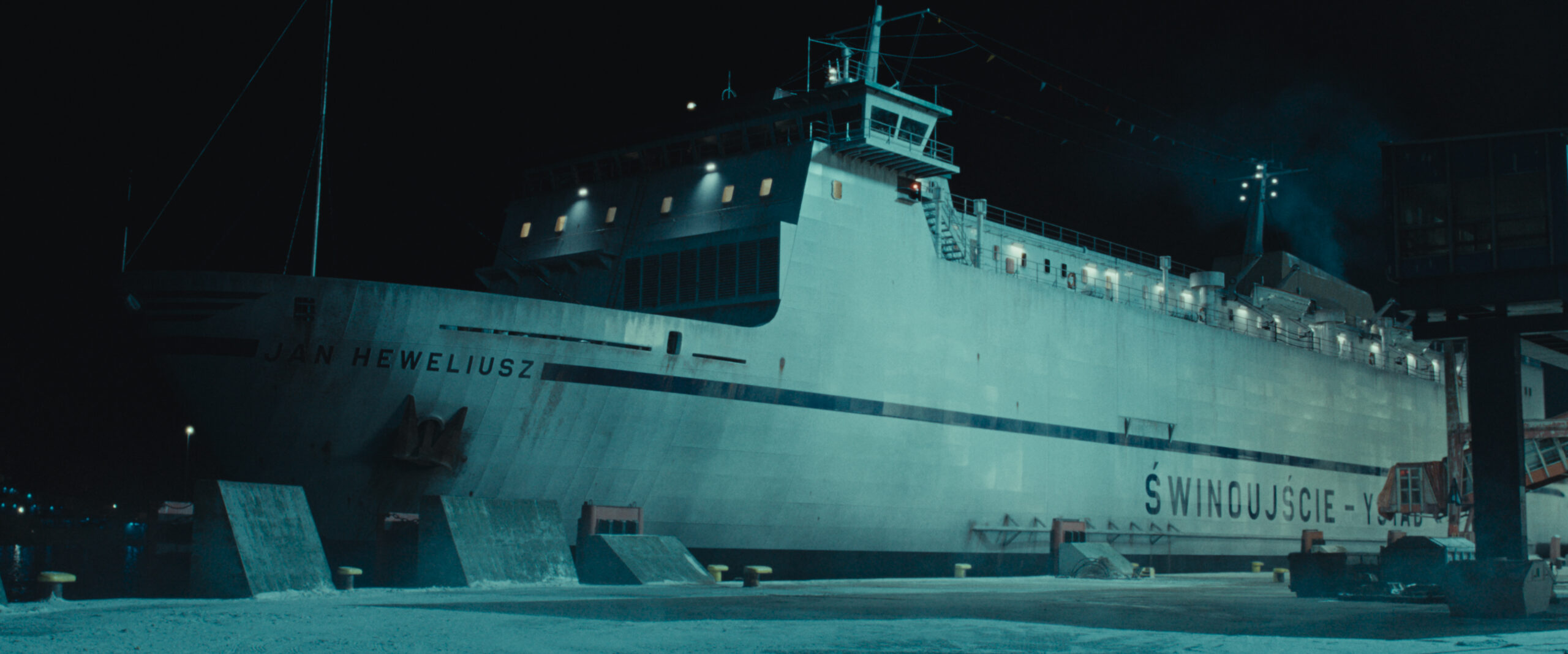
From the very beginning, it was clear that the storm sequence would become the greatest challenge of the production – both in terms of scale and the complexity of the visual effects. The film required over 500 VFX shots, with more than 130 shots dedicated solely to the storm sequence. Among them were over 45 full CGI shots featuring the Heweliusz battling massive waves and a helicopter engaged in a dramatic rescue mission. Alongside these shots, the team delivered complex composites combining material shot in a Belgian water tank and on location with high-end digital ocean simulations.
The ocean particle simulations had to capture a storm on a Baltic Sea at 12 on the Beaufort scale, corresponding to winds reaching 160 km/h (100 mph). This required creating hyper-realistic wave dynamics, spray, mist, foam and rainfall, while also ensuring the ship’s behavior in such extreme conditions felt authentic. The challenge was not only to recreate the look of the ocean, but also to maintain a consistent visual character across all shots, whether they were tank footage, studio setups, or full CGI.
Even during principal photography, the VFX team worked in close collaboration with the director and production crew. Thanks to this cooperation, the team was able to begin work on part of the storm sequence while shooting was still underway – essentially halfway through production. This parallel workflow enabled faster testing of concepts and more efficient preparation of the pipeline for the most demanding scenes.
The production also faced a particularly tricky practical problem: the script called for a sequence in which a truck overturns inside a cargo hold. On set, this could only be attempted once – and there was an added complication: the vehicle used in the scene was a rare, vintage model, practically impossible to replace. Physically toppling it would have meant irreversible destruction. This is where VFX stepped in. The team proposed a full digital reconstruction of both the truck and the environment in CGI. This not only preserved the unique vehicle but also gave the director full creative control over the action while optimizing the production approach.
The pipeline was carefully designed so that simulations, rendering, and compositing ran in parallel, eliminating downtime. One of the biggest challenges was the inertia of large-scale ocean simulations – every restart carried huge time and computational costs. To mitigate this, the team implemented low-resolution test runs and layered caching strategies.
It’s important to note that the storm was not the only area of VFX work. “Invisible” effects accounted for nearly 75% of all VFX shots across the entire series. Their scope ranged from straightforward clean-ups and paint-outs to complex sequences requiring the integration of multiple techniques. The team digitally added snow – both on the ground and falling in the air – and generated realistic cold breaths for the actors in storm conditions. Subtle yet technically demanding RBD simulations were created, such as plates falling from shelves, objects shifting on the ship’s deck, and minor destruction moments. In other sequences, entire city districts were digitally replaced, using a combination of 2.5D mattepainting and 3D set extensions to create entirely new environments. Military helicopters were added to a base, with rotors being ready for takeoff. Some practical explosions captured on set were digitally enhanced to appear even more spectacular. It was an immense volume of work that largely remains unseen by the audience, but which played a crucial role in building the authenticity and credibility of the production.
The result is a project that combines spectacular, fully computer-generated storm imagery with subtle, invisible effects that enhance the storytelling. Thanks to cutting-edge technology and close collaboration with the filmmakers, the team succeeded in crafting a coherent and realistic vision of nature at its most extreme – while simultaneously telling a deeply human story of personal tragedy that unfolded more than three decades ago.